Resource context and contributors
This resource is an article published by the Green European Journal. It brings together perspectives from Barcelona-based community organiser Daniel Pardo Rivacoba (Neighbourhoods for Tourism Degrowth), geography professor Asunción Blanco-Romero (Autonomous University of Barcelona), and sociology professor Robert Fletcher (Wageningen University), with the article focusing on how mass tourism is reshaping cities and housing.
Tourism pressure in Barcelona in numbers
Barcelona receives more than 170,000 tourists every day. Official monitoring bodies estimate around 26 million tourists visited in 2023, while grassroots movements argue the figure is closer to 31 million a year—almost 20 times the city’s permanent population of roughly 1.6 million. Many visitors stay fewer than two nights, reflecting a wider European tourism surge: Eurostat reported 1.19 billion overnight stays in the EU in the first half of 2023.
Housing impacts and daily life in the city centre
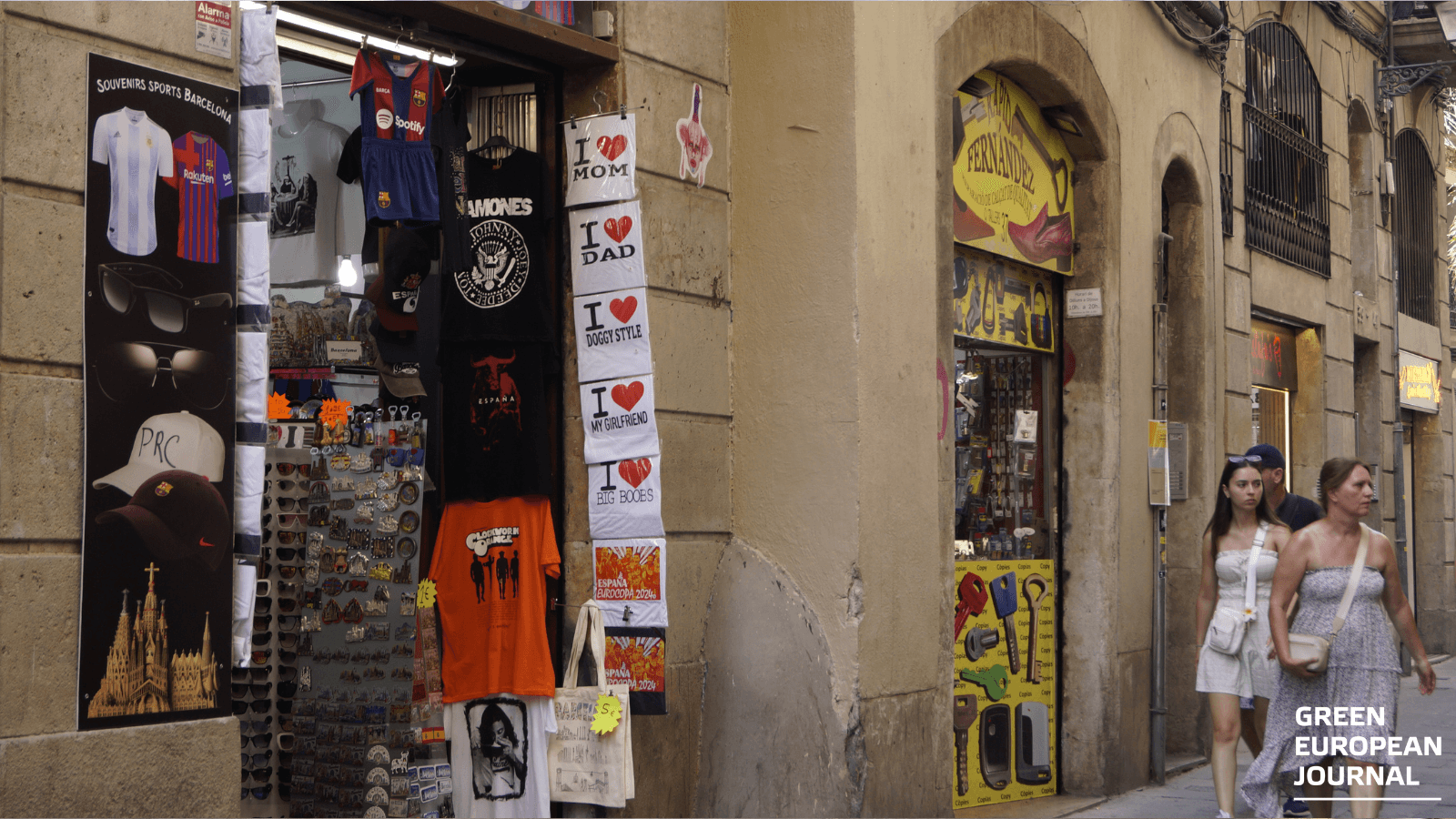
The article describes how housing markets are affected when homes shift toward hotels and short-term rentals. Daniel Pardo Rivacoba says housing prices in central neighbourhoods have continued to rise as the area is oriented toward the tourism market, forcing many residents to leave. Remaining residents report knock-on effects tied to tourism concentration, including persistent nighttime noise and a shrinking supply of affordable everyday services, with local commerce increasingly geared toward visitors.
Protest demands and proposed municipal measures
Public frustration is portrayed as long-running (including “tourists go home” graffiti) and recently escalating into street protests. Grassroots groups’ manifesto calls for measures such as limiting the number of cruise terminals, banning new tourist accommodation construction, ending tourism-sector privileges over water rights, and restoring commerce and leisure infrastructure for residents. In response, Barcelona’s mayor announced plans to cancel all short-term rental licences by 2028 to increase housing for locals, ban cruise ships from docking in the city centre, and raise tourism taxes. The article notes similar policy moves elsewhere, including Madrid’s announcement of a pause on granting new tourism licences pending a new 2025 strategy.
“Tourism degrowth” and governance debates
The piece frames “degrowth” as a central proposal from the Neighbourhoods for Tourism Degrowth movement. Asunción Blanco-Romero describes planned, consensual public regulations intended to shape “an adequate tourism model” for each area, with the explicit aim of improving residents’ lives within a finite planet. Activists are sceptical of political announcements they see as insufficient without broader shifts in city governance and enforcement.
Environmental footprint, water stress, and European parallels
The article links tourism intensity to environmental constraints and climate impacts. A 2023 report is cited estimating travel and tourism account for about 8.1% of global CO2 emissions. Additional figures cited include estimates of 17–50 kg of CO2 per guest overnight stay (German Hotel and Restaurant Association, reported by DW) and water consumption in five-star hotels of up to 522 litres per person per day. Barcelona’s drought emergency and water restrictions are used to illustrate resource stress, alongside examples from other cities facing tourism pressure, including Venice, Dubrovnik (about 1.5 million visitors yearly for a population around 41,000), and Amsterdam’s stated cap of 20 million tourists per year.
Equity, accessibility, and who benefits from tourism
Robert Fletcher argues that relying on free-market dynamics can make travel increasingly elitist, and the article discusses options aimed at keeping travel accessible while reducing impacts, such as price caps, allocating transport seats by income brackets, and banning elite transport like private jets and yachts. The article also shifts attention to profit distribution, citing a UNEP estimate that in some destinations about 95% of tourist spending historically leaked out of local economies to foreign-owned operators and supply chains. In Barcelona, the article highlights the influence of digital platforms, real estate investors, and airline companies, and it reports criticism that tourism tax revenues are often directed toward promotion and private-sector priorities.
Toward a pan-European conversation on sustainable city living
The article concludes by describing efforts to build Europe-wide dialogue on tourism policies, including influencing European-level debates that shape national legislation. The Neighbourhoods for Tourism Degrowth movement is presented as seeking cross-city coordination so local voices are more present in discussions about tourism, housing, and sustainability, especially as international forums have been perceived as excluding civil society perspectives.